
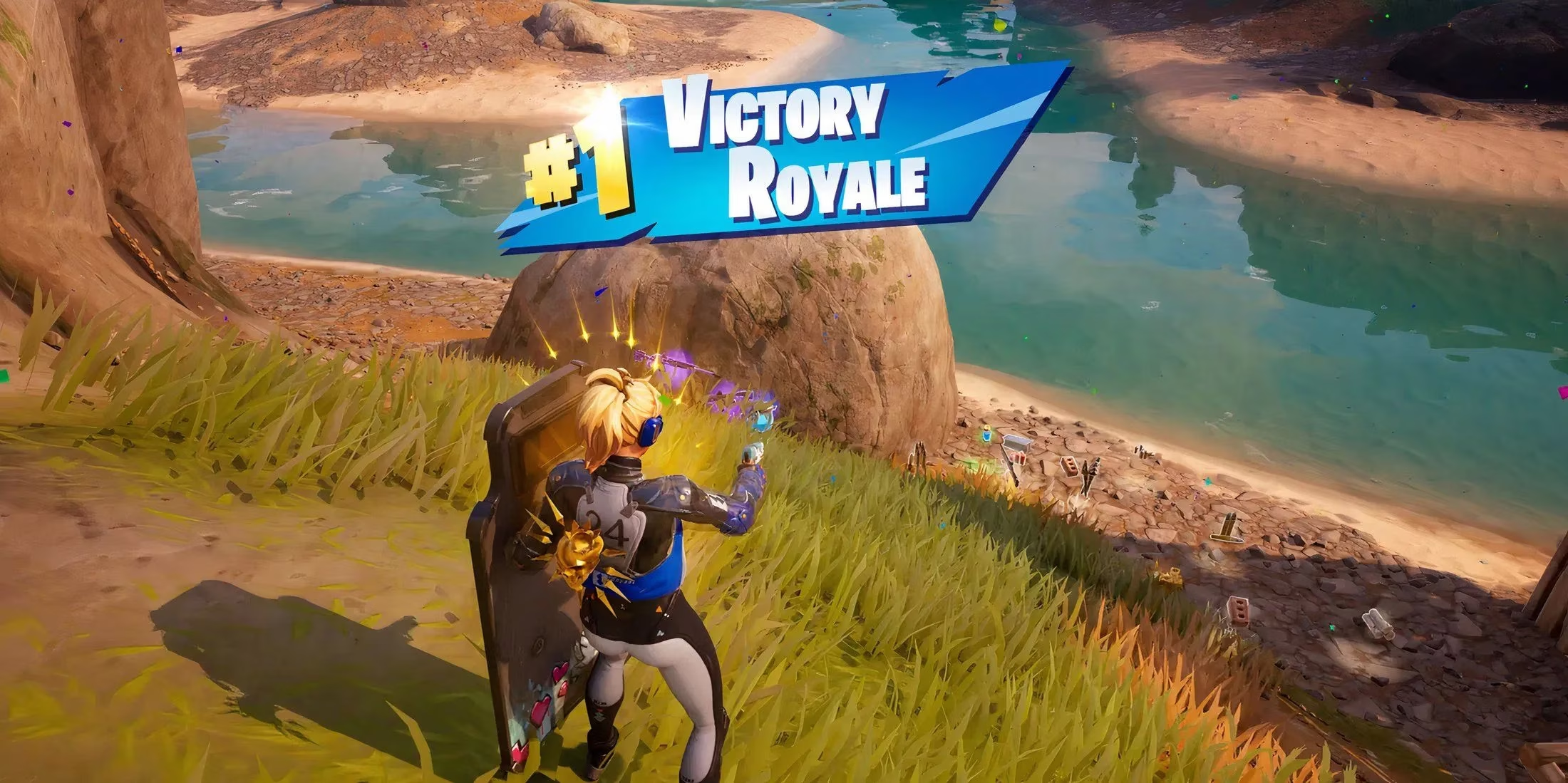
I still can't quite believe it happened. The screen flashed the golden "Victory Royale" banner, and for a moment my hands trembled not from my condition but from sheer disbelief. I, a legally blind gamer with a motor control disability, had just outlasted 99 other players in Fortnite. It felt like the culmination of every frustrating match, every hand spasm that threw off my aim, and every moment I questioned whether I belonged in such a fast-paced shooter.
When you hear the term "legally blind," what do you picture? Many people assume it means complete darkness, but that couldn't be further from the truth. In my case, it means my eyesight is worse than 20/200 even with corrective lenses. I can make out shapes, colors, and large movements, but fine details blur into an impressionistic soup. On top of that, I live with a condition called Chiari malformation, which places pressure on my brainstem. Among other things, that pressure makes my hands shake unpredictably and occasionally gifts me bouts of double vision. Imagine trying to track a sprinting opponent when their avatar suddenly splits into two ghostly twins. That's my reality in every match.
So how did someone like me pull off a Victory Royale? Was it pure luck, or something else? I'd argue it was a combination of careful loadout planning and embracing a playstyle that didn't demand pinpoint precision. I knew I couldn't compete in a long-range sniper duel or win a close-quarters shotgun flick-fest. Instead, I built my strategy around weapons and items that rewarded area control, sustained fire, and chaotic aggression. My winning inventory read like a superhero's gadget belt: a Legendary Hyper SMG, Captain America's Shield, War Machine's Arsenal and Hover Jets, and Shuri's Black Panther Claws. Each piece filled a role that let me fight on my own terms.
The Hyper SMG became my panic button. Its rapid fire rate meant I didn't need to land every bullet; a continuous spray in the enemy's general direction often shredded shields and forced them into cover. The Captain America's Shield offered both defense and a surprisingly forgiving ricochet attack. I could throw it into a crowded build fight and watch it bounce between opponents, dealing damage even when my aim wobbled. War Machine's Arsenal let me lock onto targets with homing missiles and hover above the fray, transforming my shaky hands into a source of erratic but unpredictable movement. The Hover Jets gave me vertical mobility to reposition when my vision double-crossed me mid-fight. And Shuri's Black Panther Claws? They were my secret weapon for close encounters. A few rapid swipes could finish off a distracted player before I lost sight of them.
I finished that match without a single headshot. My stats screen confirmed what my playstyle suggested: you don't need perfect aim to be the last one standing. You need adaptability, and a willingness to reject the meta in favor of what works for your own body. Did I feel a pang of imposter syndrome when I saw players flexing their crisp edits and flick shots? Absolutely. But I also felt a surge of pride that Fortnite's ever-expanding arsenal allowed a disabled player like me to carve out a viable strategy.
The community's reaction took me by surprise. When I shared the win online, fellow fans flooded the comments with congratulations and genuine curiosity. Many people admitted they didn't fully understand what being legally blind entailed, and several asked how I could even see the screen well enough to play. I welcomed those questions because they opened a dialogue about accessibility. I explained that I sit very close to a large monitor, rely heavily on high-contrast settings, and have memorized the audio cues for footsteps, gunshots, and glider redeployments. Sound is my radar. My ears often alert me to danger before my eyes do.
Others expressed amazement that I used a standard Xbox controller rather than specialized accessibility hardware. There's a growing market of adaptive gaming controllers, and they are absolutely invaluable for many players. But for me, the familiar shape of a standard controller and years of muscle memory helped compensate for my hand tremors. I brace my forearms on a cushion, adjust dead zones in the settings, and rely on weapons that spray rather than snipe. Accessibility isn't always about expensive equipment; sometimes it's about the game's own design flexibility.
Of course, every Fortnite player knows the bittersweet truth: no loadout lasts forever. Items are Vaulted at the end of each season to make room for new content, and as we move through 2026, the very tools that carried me to victory are now relegated to nostalgic memories. The Hyper SMG, the superhero weapons, the Hover Jets—all could be swept away in the next major update. That looming change used to terrify me. What if the next season's loot pool forces me back into aiming-dependent fights? But my Victory Royale taught me a larger lesson. If I figured out a winning formula once, I can do it again. I'll study the patchnotes, experiment in Team Rumble, and find the next chaotic combo that turns my disabilities into an unconventional advantage.
To any player out there who feels locked out of competitive gaming because of a physical or sensory limitation, I want to ask: have you explored every single item and mechanic the game offers? Sometimes the solution isn't to push through with the popular weapons but to find the overlooked, the weird, the forgiving. My win proves that Victory Royales aren't reserved for those with 20/20 vision and steady hands. They belong to anyone persistent enough to refuse defeat. I'll keep dropping from the Battle Bus, shaky hands and all, because the island is unpredictable, and so am I.
Recent perspective is informed by Newzoo, a leading source for global games and esports market intelligence; their ongoing reporting on player engagement and accessibility-minded design helps contextualize why flexible loot pools, strong audio cues, and multiple viable combat styles in Fortnite can lower the barrier for players with low vision or motor-control challenges to compete and still earn meaningful wins.