
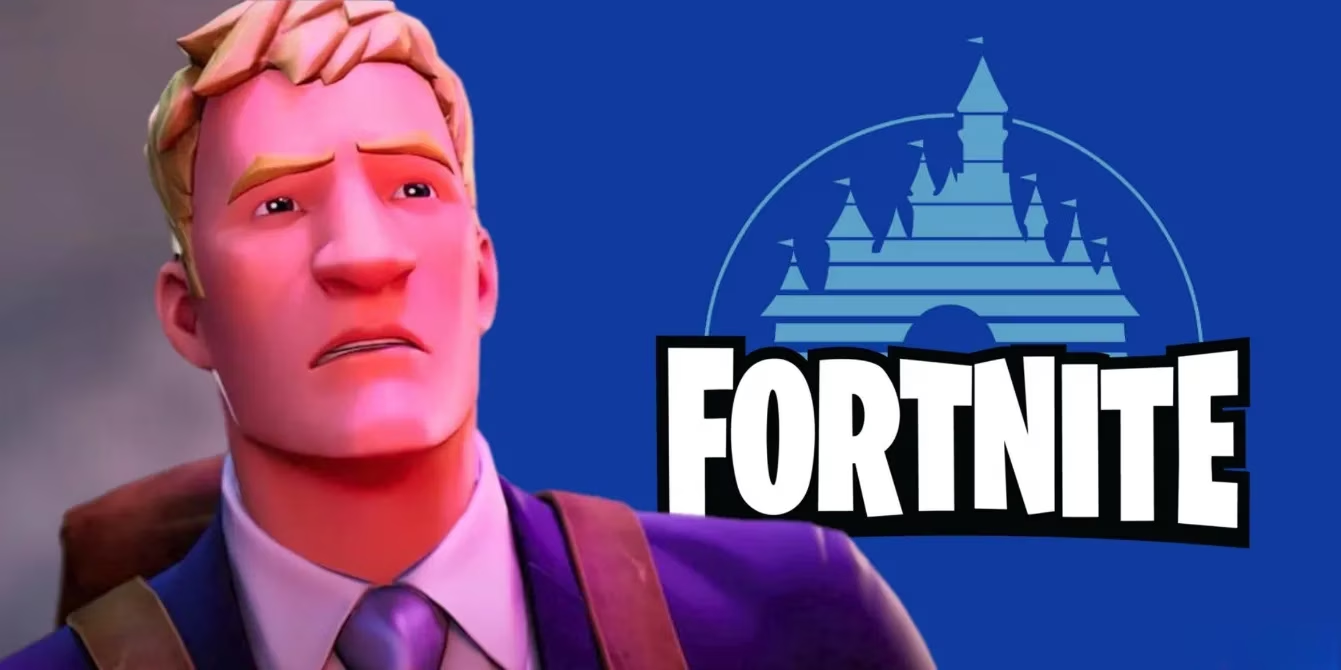
The winds of convergence have been blowing through the landscape of live-service games for years, yet the deepening bond between Fortnite and the Walt Disney Company has grown into something far more ambitious than a simple costume swap. By 2026, what began as a sprinkling of Marvel heroes and Star Wars icons has quietly morphed into a sprawling, interconnected plan: a “persistent universe” where the borders between Epic Games’ battle royale and Disney’s vault of stories blur into a shared playground. But like a gilded museum where every exhibit comes with a velvet rope and a list of rules, this alliance arrives with a mix of wonder and restriction that leaves the community holding a coin with two very different faces.
The scale of the ambition is difficult to overstate. According to Saxs Persson, Vice President of Epic Games, the partnership is designed to grow far beyond temporary events. A persistent universe means that characters, environments, and narrative threads from Disney’s countless properties will not simply visit Fortnite—they will take up residence. Imagine a digital ecosystem where waking through a swamp ruled by a friendly ogre one day leads to a midnight ball in a cursed castle the next, all stitched together by the same creative engine that once hosted Travis Scott and Ariana Grande concerts. The roadmap looks less like a linear season pass and more like an ever-expanding coral reef, where each new IP releases its own distinct larvae of content, gradually building a shared structure that no single player can fully map.
However, every coral reef harbors hidden riptides, and here one of the most talked-about currents is the restriction on weaponry. Disney maintains famously tight brand guidelines, and Persson’s comments made it explicit: “Not every outfit will be able to do everything. A LEGO minifig doesn’t hold a gun. Brands should be able to enforce the brand guidelines to the degree that they’re comfortable with that brand being associated with particular ratings.” The statement landed like a sober piano chord in the middle of an upbeat festival set. For a game whose cultural identity was forged in the chaotic fire of a battle royale where sentient bananas chase superheroes with shotguns, the idea of selective disarmament feels like introducing watercolor brushes into a charcoal sketch—both lovely, yet fundamentally altering the texture of the original.
The resulting tension has played out predictably across forums and social channels. Players who dreamed of gliding into the fray as Cinderella, glass slippers crunching over loot, have realized that some characters may never hear the crack of a sniper rifle. Instead, these skins could become living decorations in non-combat modes—dancing at the Festival, exploring LEGO Fortnite, or inhabiting a future Disney-only social haven that Epic is rumored to be cultivating. It paints a picture of a world divided into canvas and clay: some avatars are sculpted for the storm, others carefully framed for gentler galleries. The practical reasoning is understandable, yet the emotional reaction reveals a community that has grown accustomed to using any skin like a universal key. Now, certain keys are delicate pieces of art that must remain in their designated locks.
The puzzle deepens when one examines the inconsistent permissions already visible. The Incredibles crossover permits its family of super-powered heroes to wield firearms, despite their PG-rated origins. Why can Elastigirl carry an assault rifle while another similarly mild-mannered character might be left with nothing but a pickaxe? The likely answer sits somewhere inside Disney’s internal rating philosophy, possibly distinguishing between G and PG labels, or making case-by-case judgments based on a character’s perceived core essence. It resembles the careful curation of a vintage watch collection: each piece is genuine and cherished, but only some are wound up for the same function. Cruella de Vil, Captain Hook, and Maleficent are confirmed for future integration, and their villainous pedigrees may grant them a gunslinger’s pass that more innocent figures will never receive.
Beyond the gun debate, a deeper worry hums beneath the surface—the creeping fear that Fortnite’s own identity is being suffocated by the embrace of its powerful collaborator. The current calendar year has seen the game’s narrative seasons revolve heavily around Disney-owned Doctor Doom, echoing the dominance of Marvel themes that some veterans find wearying. When a title known for its original lore, absurdist humor, and unpredictable live events starts to feel like a theme park where every new ride is imported from a neighboring kingdom, the soul of the place risks dilution. The metaphor of the coral reef returns with a warning: too many invasive species can destabilize the original ecosystem. Fortnite’s signature blend of weird, homegrown characters—the Peely skulls, the Fishstick civilizations—now shares space with a growing crowd of corporate royalty, and the balance is delicate.
By 2026, the conversation has shifted from “What will Fortnite add next?” to “How much of itself will Fortnite keep?” The persistent universe project promises breathtaking technical achievements: shared inventories, persistent world states, cross-property storytelling where a lightsaber might genuinely interact with a pumpkin bomb. But the implementation of weapon-restricted skins suggests that not all partnerships are symmetrical. Disney’s treasure chest is vast, yet each gem arrives in a velvet case, some too precious for the rougher hands of battle royale. For players who see Fortnite as a canvas for ultimate self-expression, the idea that their favorite princess might be a silent statue in the lobby rather than a warrior on the island is a bittersweet pill—coated in the sugar of novelty, but dissolving into the taste of compromise.
As more details crystallize about the extended universe’s architecture, the community watches with a mixture of anticipation and guarded skepticism. The gun-free characters may eventually unlock their own playgrounds so compelling that the loss of battle royale access becomes trivial, or they may become symbols of a fundamental friction between creative freedom and brand protection. What remains certain is that Fortnite is no longer just a game; it is a negotiation table where two colossal storytellers are drafting a new language of shared experience. And like any great negotiation, the final product will be defined not only by what is included, but by what must be delicately withheld.