
I still remember the exact moment I stepped into the neon-washed island that hosted The Game Awards inside Fortnite, two years ago. It was 2024, and the air crackled with that peculiar electricity you only feel when a live-service world stitches itself around reality's edges. The island shimmered like a fever dream stitched from pixels—half cathedral, half digital playground—and there, standing beneath the holographic canopy, was Geoff Keighley. Not the man himself, but something stranger and more intimate: a MetaHuman double, every pore and eyelash rendered with the terrifying fidelity of a mirror that has learned to breathe. It felt less like meeting a virtual avatar and more like watching time fold over on itself, a single flame cast in resin.
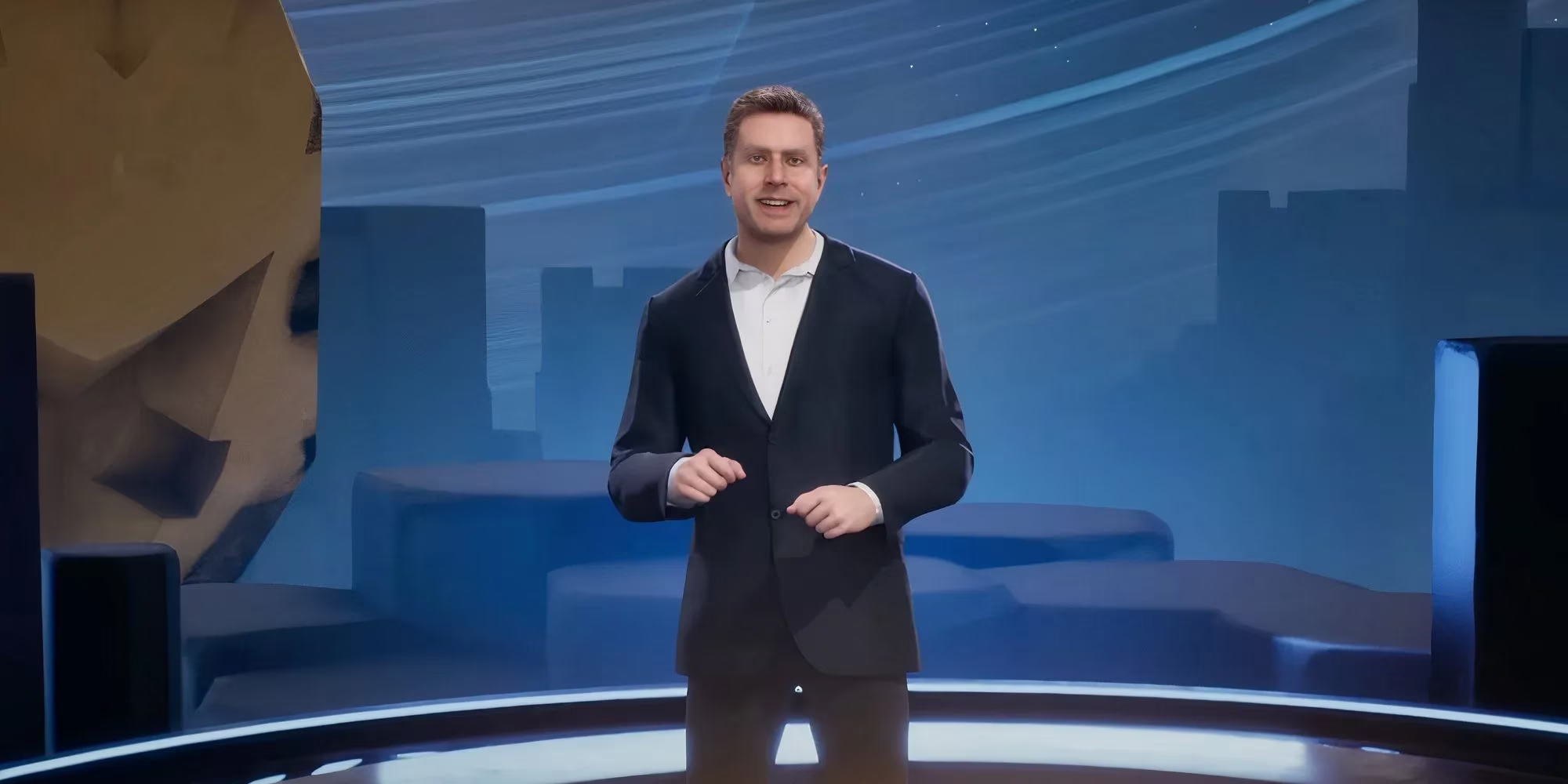
I'd been a restless wanderer in Fortnite since the battle royale days, but nothing had prepared me for that uncanny valley blooming right in the middle of a game lobby. The previous year, they'd beamed Geoff in as a greenscreen hologram—a polite ghost caught between dimensions. But 2024 brought something radically different. Epic had scanned the host at 3Lateral in Manchester, trapping his likeness in a web of polygons using the MetaHuman framework: a technology that promised to turn anyone into a "highly realistic digital human character." As he stood there, projected through Unreal Editor for Fortnite, I felt like I was watching a soul poured carefully into a data mold, a whisper given cartilage and code. The resemblance was more than just uncanny; it was a mirror polished with light, reflecting not just a face but the entire ambition of bridging our worlds.
I circled the interactive hub where fans were casting votes for Island of the Year. Beside me, a player wearing a neon banana suit paused to stare at the digital Geoff, whose lips moved in perfect synchronization with a recorded message. It was a strange ballet—a conductor whose baton was a piece of yesterday’s news, yet utterly alive. In that moment, I thought of a mayfly preserved in amber, wings still shimmering with the memory of flight. This MetaHuman was not a replacement; it was a fossil made from pure possibility, a creature born at the intersection of art and algorithm. And the irony was not lost on me: we were voting for the best user-made islands inside a game that had itself become an island, an archipelago of experiences where real and synthetic constantly traded masks.
That night, I lingered for hours. The Game Awards inside Fortnite was no longer a mere event; it had mutated into a digital festival where the audience and the stage shared the same bloodstream. I'd attended virtual concerts before—remember the Travis Scott astronomical void, Marshmello’s candy-lit set?—but this felt different. Those had been spectacles, comets blazing across a temporary sky. Geoff’s MetaHuman was a cornerstone, a deliberate stitching of celebrity and citizen into the same fabric. Seeing him there, I understood why Keighley himself said, "I truly feel like I have a digital double." It wasn't ego. It was a quiet revolution, the kind that arrives dressed as a curious novelty and stays to redefine how we remember moments.
Two years later, in 2026, the technology has seeped so deep into our daily lives that we barely blink at photorealistic digital twins ordering coffee in augmented reality or teaching university courses inside spatial web rooms. Yet I still think about that first encounter as a turning point—a pivot from watching to inhabiting. What Epic did with MetaHumans in Unreal Editor for Fortnite was like handing out skeleton keys to the uncanny kingdom. They gave creators not just tools, but a language for ghosts. My own daughter recently scanned her face using a phone app and sent an animated Mini-Me dancing through our living room via mixed-reality glasses. I watched her laugh as her tiny doppelgänger performed a flawless pirouette, and I shuddered, not from fear, but from the sheer weight of beauty packed into that moment.
The MetaHuman framework has since evolved beyond static presentations. At this year's Game Awards—now experienced in fully embodied VR by millions—I walked alongside a MetaHuman version of a legendary developer who passed away a decade ago, his wise sayings programmed from a lifetime of interviews, his movements captured from archival footage. It was a haunting library given flesh. That experience felt like conversing with a sculpture carved from starlight, where each word was a chisel held by ghosts. The line between tribute and resurrection has become a trembling thread we navigate with our hearts in our throats.
Looking back at Geoff’s digital twin in 2024, I realize it was a seed planted in the most unexpected soil—a game known for banana costumes and floss dances. The beauty of Fortnite has always been its refusal to take itself too seriously while hosting the building blocks of entire realities. To watch a game show host materialize through the same engine that powers a llama piñata is to witness the sublime hiding in the silly. It was as if someone had turned a kaleidoscope and inside, among the plastic shards, found a fragment of a Renaissance painting.
I often play back that memory like an old song, the pixels of Geoff's face unraveling into a quiet anthem of what's to come. We are all becoming MetaHumans now, in one way or another—our voices cloned, our gestures databased, our likenesses poured into the great mold of the metaverse. And while some see a dystopia, I remember that island in Fortnite and feel something closer to wonder. There, a man who loves games was turned into a star that could shine inside them, not above them. He wasn't hosting from a remote pedestal; he was standing among us, a digital citizen in a land where everyone wears the crown of their own creation. And that, I think, is the most hopeful kind of haunting there is.